

Have you ever noticed how some pimples disappear as though they were never there, while others leave little reminders behind?
Sometimes it’s a red or brown mark that slowly fades. Other times, it’s a tiny indentation, a small crater or an uneven patch of skin that seems determined to stay.
And here’s something interesting: two people can experience very similar acne breakouts, yet only one develops noticeable scars.
So what’s happening beneath the skin that makes the difference?
It turns out that acne scarring has a lot to do with inflammation, collagen and the way our skin repairs itself. And once you understand that process, the different types of acne scars start to make much more sense.
How Acne Scars Develop Beneath the Skin
Our skin is remarkably good at repairing itself. A small scratch, a minor cut or an ordinary pimple can heal without leaving much evidence behind.
But sometimes the damage goes a little deeper.
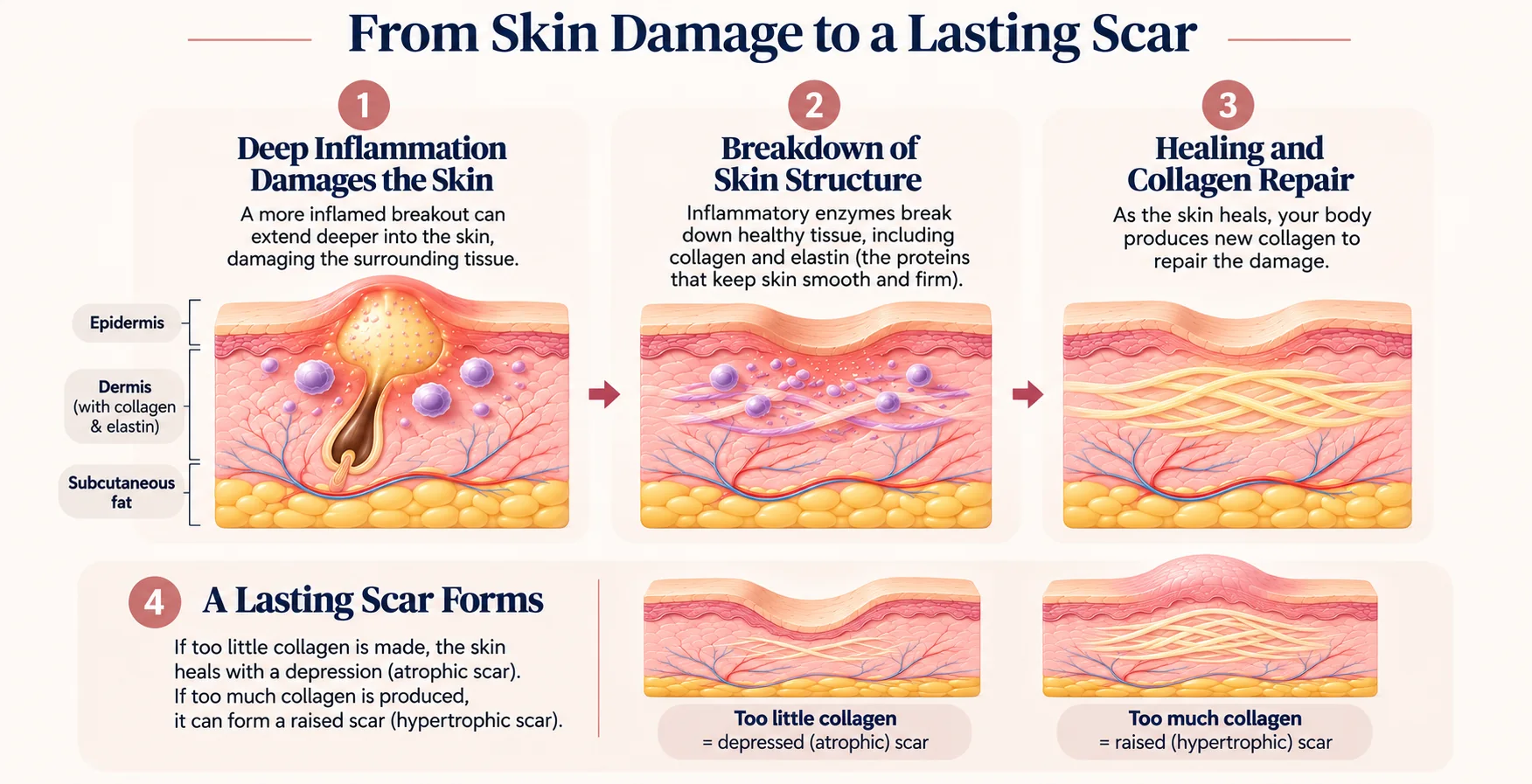
When acne develops, inflammation builds around a blocked hair follicle. With more inflammatory breakouts, particularly deep and painful ones, that inflammation can affect the surrounding skin tissue.
Now your body has some repair work to do.
One of its most important building materials is collagen, a protein that helps give skin its strength, firmness and structure.
Think of collagen as part of the supporting framework beneath the skin’s surface. When inflammation damages that framework, the body tries to rebuild it.
But the rebuilding process doesn’t always produce exactly the same structure as before.
If too much collagen is broken down and not enough is replaced, the skin may heal with a small depression. If the body produces too much collagen during repair, the result can be a raised scar.
That’s the basic story behind acne scarring: the skin heals, but its original structure isn’t always perfectly restored.
A scientific review published in 2017 by Connolly and colleagues explored this process in detail. The researchers explained how inflammation and changes in collagen production contribute to acne scars. They also reported that approximately 80–90% of acne scars are atrophic, meaning they’re associated with a loss of collagen rather than an excess of it. [1]
In other words, those little pits and depressions commonly seen on the cheeks aren’t simply leftover pimples. They’re the visible result of changes that happened deeper in the skin. And that brings us to another interesting question: why doesn’t this happen to everyone?
Why Some People Are More Prone to Scarring
You might know someone who experienced years of acne but has relatively smooth skin today. Meanwhile, someone else may have developed scars after a much shorter period of breakouts.
It doesn’t seem particularly fair, does it?
The explanation is that acne scarring isn’t determined by just one factor.
Some breakouts go deeper than others
A small whitehead and a large, painful acne nodule aren’t doing the same thing beneath the skin.
Deeper inflammatory lesions can cause more extensive tissue damage, increasing the likelihood that the skin will heal with a scar.
This is one reason severe inflammatory acne is associated with a greater risk of scarring.
But it’s worth remembering that even acne that appears relatively mild can sometimes leave scars. The severity of a breakout isn’t the only factor.
Your skin has its own way of healing
We don’t all respond to inflammation in exactly the same way.
Some people’s skin seems to recover with very little lasting change. Others may experience more pronounced inflammation or differences in how collagen is broken down and rebuilt.
Genetics may play a role, too. Having family members who developed acne scars can be an indication of greater susceptibility, although it doesn’t mean scarring is inevitable.
Picking can make things worse
We’ve probably all experienced the temptation to squeeze a particularly annoying pimple.
The problem is that squeezing or picking can cause additional trauma to skin that’s already inflamed.
This may increase tissue damage and the likelihood of scarring, especially when the same area is repeatedly picked.
But there’s an important distinction here: not all acne scars are caused by picking. Scarring can develop even when someone leaves their pimples completely alone.
Persistent inflammation matters
Acne that continues for months or years can expose the skin to repeated inflammation.
The longer inflammatory acne remains uncontrolled, the more opportunities there may be for tissue damage.
A 2018 systematic review of acne scar treatments identified acne severity, genetic factors and delays in treatment among the important influences on scar development. [2]
The practical lesson is that managing inflammatory acne early can be important, not just for clearing breakouts but also for reducing the risk of lasting scars.
Understanding the Different Types of Acne Scars
Here’s where things get particularly interesting.
Acne scars don’t all look alike because they don’t all involve the same changes beneath the skin.
Dermatologists generally describe two broad categories: depressed scars, where the skin has lost supporting tissue, and raised scars, where excess scar tissue has developed.
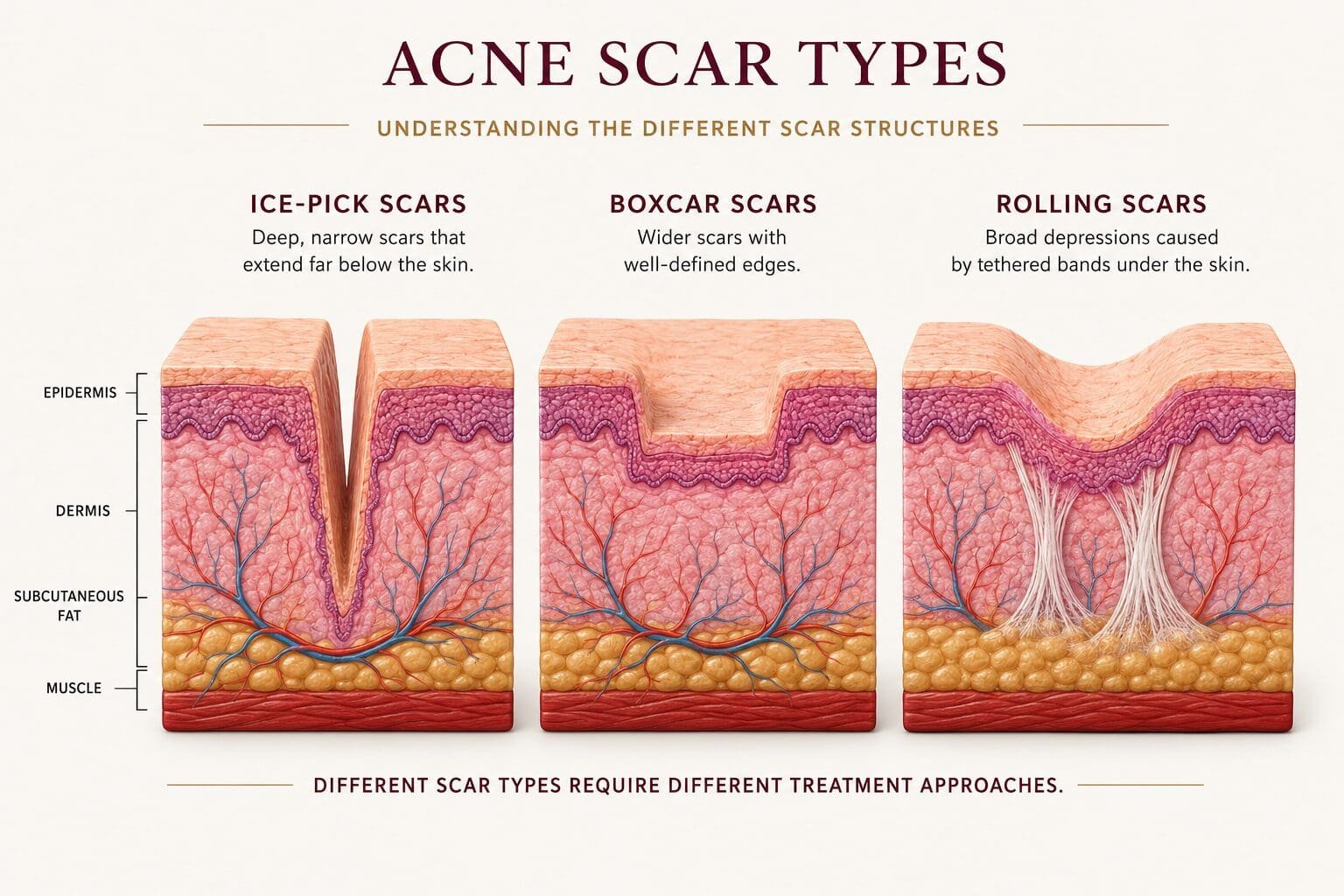
Depressed scars are the most common, and they’re usually divided into three types: ice-pick, boxcar and rolling scars.
The names might sound unusual, but they’re actually quite descriptive.
Ice-Pick Scars: Small Openings, Deeper Damage
Imagine a tiny, narrow hole in the surface of the skin, almost as though it had been punctured by a sharp point.
That’s the appearance of an ice-pick scar.
These scars are usually very narrow at the surface, but they can extend surprisingly deep into the skin.
They’re often seen on the cheeks and may look like little pinholes, particularly when you examine the skin closely.
What makes them interesting is that their surface appearance can be misleading. A tiny opening doesn’t necessarily mean the scar is shallow.
Ice-pick scars can extend deep into the dermis, which makes their underlying structure quite different from that of broader, more superficial scars.
Boxcar Scars: Small Craters with Defined Edges
Boxcar scars look more like little craters.
They’re usually round or oval, with relatively sharp edges and a flatter base.
Some are shallow enough to create only a subtle change in texture. Others are deeper and become much more noticeable when light falls across the face.
Unlike ice-pick scars, which narrow as they extend downward, boxcar scars tend to have wider openings and more defined sides.
If you’ve ever noticed small, clearly outlined depressions on someone’s cheeks or temples, they may be boxcar scars.
Rolling Scars: When the Skin Develops a Wavy Texture
Rolling scars are a little different.
Instead of creating individual holes or sharply defined craters, they produce broader depressions that make the skin appear uneven or wavy.
One reason this happens is that bands of fibrous tissue can develop beneath the skin, connecting the surface to deeper structures.
These attachments can pull the skin downward, creating the characteristic rolling appearance.
And here’s something you may have noticed: rolling scars can look much more obvious under certain lighting.
That’s because the uneven surface creates shadows. Under soft, even lighting, the skin might appear relatively smooth, while side lighting reveals the depressions much more clearly.
It’s also common to have several scar types at once. Someone might have a few ice-pick scars alongside broader rolling scars and some shallow boxcar scars.
So acne scarring isn’t always something that fits neatly into a single category.
Raised Scars: When the Skin Produces Too Much Collagen
So far, we’ve been talking about scars that develop when the skin loses supporting tissue.
But sometimes the opposite happens.
During healing, the body may produce too much collagen, creating a raised area of scar tissue.
These scars generally fall into two categories.
Hypertrophic scars are raised scars that stay within the boundaries of the original area of injury.
Keloid scars extend beyond the original injury and may continue growing.
Raised acne scars are more often seen on areas such as the chest, shoulders and back, although they can occur elsewhere.
Some people are also more genetically prone to developing keloids.
The important difference is that raised and depressed scars involve different healing responses. One develops with a loss of supporting tissue; the other involves excessive scar tissue formation.
What Research Reveals About Acne Scarring
You might be wondering how dermatologists came up with categories such as ice-pick, boxcar and rolling scars.
They’re not simply descriptive names invented for cosmetic marketing.
In 2001, researchers Jacob, Dover and Kaminer published a paper in the Journal of the American Academy of Dermatology describing a classification system for acne scars. [3]
Their work helped establish a practical way to distinguish depressed scars by their shape and structure.
Why does that matter?
Because the visible shape of a scar can provide clues about what’s happening underneath it.
A narrow ice-pick scar may extend deeply into the skin. A boxcar scar may have relatively well-defined edges. A rolling scar may involve fibrous attachments pulling the skin downward.
A later review by Connolly and colleagues in 2017 built on this understanding, discussing how different scar types reflect different patterns of tissue damage and healing. [1]
These papers are reviews and classification research rather than experiments proving that one particular person will develop a particular scar. But they provide an important foundation for understanding why acne scarring needs to be assessed individually.
The interesting part is that two scars can look quite similar from a distance while having very different structures beneath the surface.
And that helps explain why understanding scar types is so useful.
Acne Scars vs. Post-Acne Marks: They’re Not Always the Same Thing
Here’s a distinction that can save a lot of confusion.
Not everything left behind after a pimple is a scar.
Sometimes a breakout disappears but leaves a red, pink, brown or darker patch on the skin.
These marks can last for weeks or months, occasionally longer, and they may be just as frustrating as a scar.
But the underlying problem is different.
Red and pink marks after acne
These are often described as post-inflammatory erythema, or PIE.
They develop in association with changes in the small blood vessels and inflammation remaining after an acne lesion has healed.
They can appear pink, red or purplish, depending on skin tone and other factors.
Brown and darker marks after acne
These are commonly called post-inflammatory hyperpigmentation, or PIH.
Inflammation can stimulate the skin to produce additional melanin, the pigment responsible for skin colour.
The result is a flat patch of discolouration that remains after the original breakout has gone.
PIH can be particularly persistent and is more common or noticeable in people with more richly pigmented skin.
The important difference: colour versus texture
Here’s a useful way to think about it.
If the skin feels relatively smooth but has a lingering change in colour, you may be looking at a post-acne mark.
If the skin has a persistent indentation, crater or raised area, there may be structural scarring.
Of course, the two can happen together. A depressed acne scar can also have redness or pigmentation around it.
And appearances alone aren’t always enough for an accurate diagnosis.
But recognising this difference is important because changing skin colour and repairing altered skin structure are not the same challenge.
Do Acne Scars Fade Over Time?
This is where expectations matter.
Our skin doesn’t stop changing once a pimple disappears. Healing and remodelling can continue for some time afterward.
Flat post-acne marks often fade gradually as inflammation settles and pigmentation changes resolve.
True structural scars are different.
When the skin has lost collagen or developed fibrous attachments, those changes generally don’t disappear completely just because enough time passes.
Some scars may soften or become less noticeable over time, but established depressions can remain for years.
That doesn’t mean their appearance can never improve. It simply means there’s a difference between waiting for a temporary mark to fade and expecting a deeper structural scar to repair itself entirely.
This also explains why a skincare product that helps with pigmentation won’t necessarily make a deep indentation disappear.
The two concerns may look related, but they’re not quite the same problem.
Why the Type of Scar Matters
Imagine two people looking in the mirror.
One notices a few narrow, deep pits on their cheeks. The other sees broader areas of uneven texture that become more obvious in sunlight.
Both may describe their concern as acne scarring. And both would be correct.
But the changes beneath their skin aren’t necessarily the same.
That’s why identifying the scar type, its depth and its underlying structure is such an important part of understanding acne scarring.
Skin tone, the presence of active acne, the location of scars and a person’s individual healing response can also influence how scarring is assessed.
In our separate guide to acne scar treatment in Melbourne, we’ll explore how different professional treatments work, what the research says about their effectiveness, and why some approaches are more appropriate for particular scar types than others.
For now, the most useful thing to remember is that acne scarring isn’t one single condition with one single appearance. It’s a collection of different changes that can happen as the skin heals.
A Final Thought
There’s something fascinating about the way our skin remembers inflammation.
A pimple might last only a few days, but the healing process beneath it can sometimes leave changes that remain for years.
And those changes aren’t necessarily a reflection of how well someone cared for their skin.
Acne scarring involves a complicated interaction between inflammation, collagen, genetics and the body’s natural repair mechanisms. Understanding that process helps us appreciate why scars look different, why some people develop them while others don’t, and why not every mark left behind by acne is actually a scar.
If you’re noticing small pits, uneven texture or lingering post-acne marks, understanding what you’re seeing is a good place to start.
And if you’re curious about what might help, you can explore the scarring treatment options available at Medix Skincare & Laser Clinic in Bentleigh, Melbourne.
After all, caring for your skin doesn’t always begin with a treatment. Sometimes, it begins with simply understanding it a little better.
Frequently Asked Questions
Can mild acne leave scars?
Yes. Although deeper inflammatory acne is more likely to cause scarring, some people develop scars after breakouts that appear relatively mild. Individual healing responses also influence the outcome.
Are acne scars always permanent?
Structural acne scars often persist without treatment, although their appearance may change or improve. Flat red or brown post-acne marks are different and may fade naturally over time.
Why do my acne scars look worse in certain lighting?
Depressed scars create small shadows. When light hits the skin from the side, those shadows can make uneven texture more noticeable.
Can I have different types of acne scars at the same time?
Absolutely. Many people have a combination of ice-pick, boxcar and rolling scars, sometimes alongside post-inflammatory redness or pigmentation.
Does squeezing pimples always cause scarring?
No, but it can increase inflammation and tissue damage, raising the risk. Scarring can also happen without any picking or squeezing.
Scientific References
- Connolly D, Vu HL, Mariwalla K, Saedi N. (2017). Acne Scarring—Pathogenesis, Evaluation, and Treatment Options. Journal of Clinical and Aesthetic Dermatology, 10(9), 12–23. Read the research.
- Kravvas G, Al-Niaimi F. (2018). A systematic review of treatments for acne scarring. Part 1: Non-energy-based techniques. Scars, Burns & Healing. Read the review.
- Jacob CI, Dover JS, Kaminer MS. (2001). Acne scarring: A classification system and review of treatment options. Journal of the American Academy of Dermatology, 45(1), 109–117. Read the research.
- Practical Aspects of Acne Scar Management: ASAP 2024. (2024). Read the review.