Have you ever wondered why you keep getting pimples, even when you’re taking good care of your skin?
Perhaps your skin seems perfectly clear one week, only for a few unexpected breakouts to appear the next. Or maybe you’ve noticed that your acne gets worse around your period, during stressful times or for no obvious reason at all.
It’s tempting to blame your skincare routine, something you’ve eaten or the fact that you haven’t washed your face often enough.
But acne is a little more complicated than that.
Acne isn’t simply caused by dirty skin or poor skincare habits. It’s an inflammatory skin condition influenced by hormones, oil production, blocked hair follicles, bacteria and the way your skin responds to inflammation.
And much of this happens beneath the surface, before you can even see a pimple forming.
Understanding these processes can help you make better decisions about your skin, recognise possible triggers and avoid treatments that aren’t addressing the real concern.
Let’s start with what’s actually happening.
What Really Causes Acne?
Our skin is constantly working to protect itself. It produces natural oils, renews its cells and maintains a delicate balance of microorganisms that form part of its protective environment.
Most of the time, these processes happen without us noticing. But sometimes, the balance changes.
Acne develops when several processes interact inside the hair follicles, the tiny structures in our skin that contain hair and connect to oil-producing glands.
These glands, known as sebaceous glands, produce sebum, a natural oil that helps keep the skin moisturised and protected.
Normally, sebum moves through the follicle and reaches the skin’s surface.
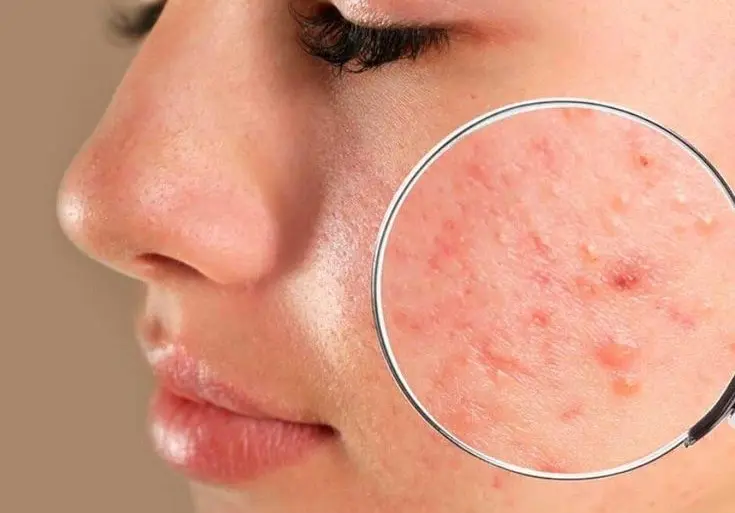
But when oil and skin cells accumulate inside the follicle, they can form a blockage. Depending on what happens next, this may develop into a blackhead, whitehead or inflamed pimple.
Acne commonly appears on the face, forehead, chin, jawline, chest and back because these areas contain more active sebaceous glands.
Although acne often begins during puberty, it can develop or continue well into adulthood.
The important thing to remember is that acne begins with changes in how the skin functions, not simply how clean it is.
How Does Acne Develop? Four Key Processes
A pimple doesn’t appear out of nowhere. What we see on the skin’s surface is often the result of several changes happening beneath it.
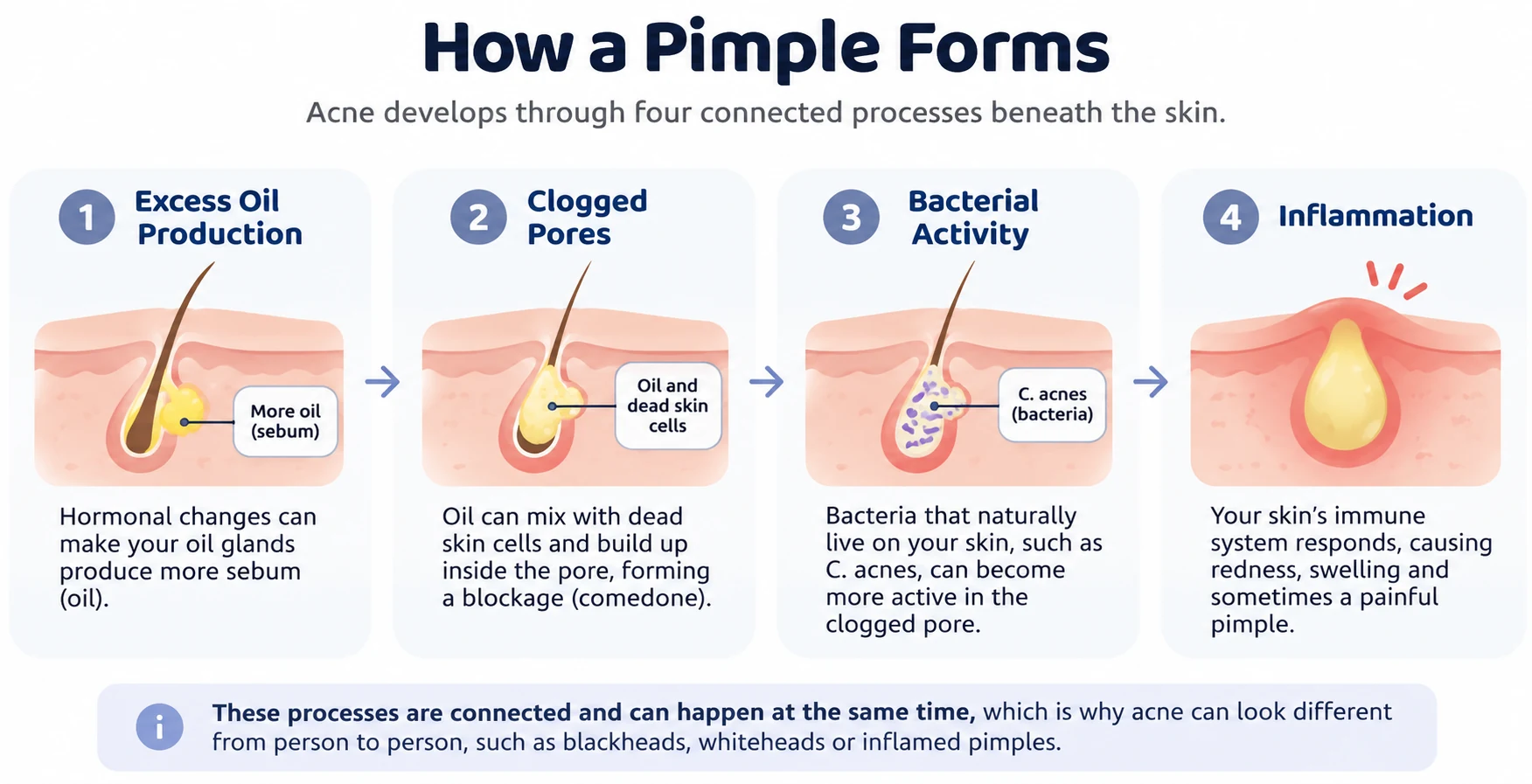
Scientific research has identified four key processes involved in acne development: excess oil production, clogged pores, bacterial activity and inflammation.
These processes are closely connected and can happen at the same time. Understanding how they work helps explain why some people experience occasional pimples while others struggle with persistent breakouts.
A scientific review of acne development explains how these biological processes interact and contribute to acne.
01. Excess Oil Production
Our skin naturally produces an oil called sebum, which helps keep it moisturised and protected.
However, certain hormones, particularly androgens such as testosterone, can stimulate the sebaceous glands to produce more oil.
When excess sebum builds up inside hair follicles, it can contribute to clogged pores and create conditions that favour acne development.
Interestingly, research suggests that acne isn’t just about how much oil your skin produces. Changes in the composition of sebum may also influence inflammation.
A 2019 scientific review on sebaceous gland function explores how hormones regulate oil production and contribute to acne.
02. Clogged Pores
Our skin is constantly renewing itself by producing new cells and shedding older ones.
Normally, dead skin cells leave the hair follicles naturally. But in acne-prone skin, these cells can accumulate instead of shedding properly.
When they mix with sebum, they can form a blockage inside the follicle.
This blockage, known as a comedone, can develop into a whitehead or blackhead.
Despite what many people believe, blackheads aren’t caused by dirt. Their dark appearance is mainly due to oxidation of material within the open follicle.
This is why washing your face more frequently or scrubbing harder won’t necessarily prevent clogged pores.
03. Bacterial Activity
Our skin naturally contains microorganisms that form part of its microbiome.
One of these is Cutibacterium acnes, commonly known as C. acnes, a bacterium that normally lives inside hair follicles.
Although it’s often associated with acne, this bacterium isn’t necessarily harmful.
Problems can arise when changes inside the follicle affect the balance and activity of these bacteria.
Certain strains of C. acnes and their interactions with the skin’s immune system can contribute to inflammation and acne development.
Research increasingly suggests that acne isn’t simply caused by having too many bacteria. It’s also influenced by how bacteria interact with the skin and its immune response.
A scientific review of acne and its underlying mechanisms discusses the role of C. acnes in inflammatory acne.
04. Inflammation
Inflammation plays an important role in acne, and it can begin even before a pimple becomes visible.
As the immune system responds to changes inside the hair follicle, the surrounding skin may become red, swollen or tender.
Some blocked pores remain as blackheads or whiteheads, while others develop into inflamed pimples.
In more severe cases, inflammation can extend deeper into the skin, leading to painful nodules or cyst-like lesions and increasing the risk of acne scarring.
This helps explain why two people with similar skin types may experience very different kinds of breakouts.
Understanding inflammation is particularly important because managing it early can help reduce the risk of persistent acne and lasting scars.
Why Hormones Have Such a Strong Influence on Acne
If you’ve noticed that your skin changes at different times of the month or at different stages of your life, hormones may be part of the explanation.
Hormones act as chemical messengers throughout the body, influencing everything from metabolism to growth and reproduction.
They also affect our skin.
Androgens, including testosterone and its more potent derivative dihydrotestosterone (DHT), stimulate sebaceous gland activity and influence processes involved in acne development.
But here’s something that often surprises people:
You can experience hormonally influenced acne even when your hormone levels are within the normal range.
Some people have sebaceous glands that respond more strongly to hormonal signals.
So two people with similar hormone levels may have very different skin.
A 2021 review titled Sex Hormones and Acne: State of the Art explains how hormonal signalling influences oil production, follicular activity and inflammation.
The relationship is therefore more complicated than simply having too much testosterone.
This is one reason acne can persist even when blood tests don’t reveal an obvious hormonal disorder.
Hormonal Changes and Acne Throughout Life
Hormones don’t remain constant throughout life.
Their activity changes during puberty, across the menstrual cycle and during different stages of adulthood.
These changes can influence how your skin behaves.
Teenage Breakouts: Why Acne Often Begins During Puberty
Puberty is one of the most common times for acne to develop.
As androgen activity increases, sebaceous glands become larger and more active. The skin may produce more oil, making follicular blockages and inflammatory breakouts more likely.
This is why teenage acne often appears on the forehead, nose, cheeks, chin, chest and back.
But not every teenager develops acne to the same degree.
Genetics, hormonal sensitivity and the skin’s inflammatory response all influence how acne develops.
Breakouts Before Your Period: What’s Happening?
Many women notice that their skin becomes more prone to breakouts in the days leading up to menstruation.
These changes may be associated with fluctuations in reproductive hormones throughout the menstrual cycle.
Some people notice recurring pimples around the chin or jawline, while others experience breakouts elsewhere on the face.
However, there’s an important misconception worth addressing.
Not every pimple on the chin or jawline is hormonal acne.
Although certain breakout patterns can suggest a hormonal influence, location alone cannot tell us what’s causing acne.
Looking at the timing, severity and overall pattern of breakouts is usually more informative.
Adult Acne: Understanding Breakouts Later in Life
Many people expect acne to disappear once their teenage years are over.
Unfortunately, skin doesn’t always follow that timetable.
Some people continue experiencing breakouts from adolescence. Others develop acne for the first time in their late 20s, 30s or 40s.
Adult acne can involve many of the same biological processes as teenage acne, including hormonal influences, follicular blockages and inflammation.
A 2025 systematic review examining adult female acne analysed 20 studies and identified hormonal influences and family history among the factors associated with adult breakouts.
The findings reinforce that adult acne often has several contributing factors rather than one simple cause.
Having acne as an adult doesn’t automatically mean you have a hormonal imbalance.
However, if persistent acne appears alongside irregular menstrual cycles, increased facial hair or other signs of androgen excess, medical assessment may be appropriate.
Why Some People Are More Prone to Acne Than Others
Have you ever noticed that some people seem to have clear skin without making much effort, while others experience persistent breakouts despite following a careful skincare routine?
It’s a frustrating comparison, but there’s a biological explanation. Part of the difference may be genetic.
Inherited factors can influence how active your sebaceous glands are, how skin cells behave inside follicles and how strongly your immune system responds to inflammation.
Genetics may also affect your skin’s sensitivity to hormonal signals.
A clinical review of adult female acne discusses how genetic predisposition can contribute to acne through several biological pathways.
This doesn’t mean acne is inevitable if your parents experienced it. It simply means some people may be naturally more susceptible to developing breakouts. And that susceptibility can interact with other factors throughout life.
Why Do Pimples Keep Coming Back?
This is one of the most common frustrations people have with acne.
You treat a breakout, your skin improves, and then another pimple appears.
Why does it keep happening? Because the underlying processes that contribute to acne may still be active even after an individual pimple has healed.
Your sebaceous glands may continue producing excess oil. Your follicles may remain prone to blockage. Or your skin may respond strongly to inflammatory changes.
And these processes can continue even when you’re washing your face regularly and following a consistent skincare routine.
External influences may also affect how frequently breakouts occur.
Stress, certain dietary patterns, cosmetics, medications and repeated friction against the skin have all been investigated as potential contributing factors.
But they don’t affect everyone in the same way.
For example, one person’s skin may be particularly sensitive to changes in hormonal activity, while another person’s breakouts may be influenced by products that contribute to follicular blockage.
This is why identifying patterns can be more helpful than assuming every breakout has the same cause.
We’ll explore these everyday influences separately in our guide to acne triggers, including what research says about stress, sleep, diet and skincare habits.
What Can You Do When Acne Keeps Returning?
Understanding the causes of acne is useful, but naturally, the next question is what to do about it.
The first thing to remember is that acne isn’t something you need to scrub away.
Excessive washing, harsh exfoliation or constantly changing skincare products can irritate the skin without addressing the biological processes behind recurring breakouts.
A more helpful approach often begins with understanding your skin type, the kind of acne you’re experiencing and whether there are patterns in your breakouts.
For some people, a gentle and consistent skincare routine may be an important part of managing mild acne.
Others may benefit from evidence-based acne treatments that address follicular blockage, inflammation or other contributing factors.
If you’re experiencing persistent breakouts, at Medix Skincare & Laser Clinic in Bentleigh, we offer personalised acne and breakout treatments based on individual skin concerns.
For painful, deep, persistent or systic acne, it’s important to seek assessment from a GP or dermatologist. Prescription treatment may be needed to control inflammation and reduce the risk of scarring.
The aim isn’t simply to make an existing pimple disappear. It’s to manage the processes that allow new breakouts to develop and prevent scarring.
A Final Thought: Understanding Your Skin Is a Good Place to Start
Acne can feel unpredictable, especially when you’re doing your best to look after your skin and breakouts keep returning.
But understanding what’s happening beneath the surface can change the way you approach it.
Acne isn’t simply about excess oil, bacteria or hormones acting alone. It’s the result of several biological processes interacting, influenced by genetics and individual skin responses.
And because everyone’s skin is different, the same skincare routine or treatment won’t necessarily work for everyone.
Rather than blaming yourself for another breakout or trying every new product that promises clear skin, it can be more useful to understand what your skin is telling you.
Sometimes, better skin care begins with a better understanding of your skin.
Frequently Asked Questions
Can You Have Hormonal Acne with Normal Hormone Levels?
Yes. Some people have normal circulating hormone levels but sebaceous glands that are particularly sensitive to androgen activity. Hormonal acne doesn’t always indicate a hormone imbalance.
Does Acne on My Chin Mean It’s Hormonal?
Not necessarily. Chin and jawline breakouts can be associated with hormonal fluctuations, particularly in adults, but their location alone cannot identify the cause.
Why Am I Getting Acne in My 30s or 40s?
Adult acne can develop because of hormonal influences, genetics, follicular activity and inflammation. Some people experience persistent acne from adolescence, while others develop it for the first time as adults.
Can Acne Run in Families?
Yes. Genetics can influence oil production, hormonal sensitivity and inflammatory responses. Having relatives with acne may increase your susceptibility, although it doesn’t mean you’ll necessarily develop it.
Is Acne Caused by Not Washing Your Face Properly?
No. Acne develops through biological processes inside hair follicles. Poor hygiene isn’t its underlying cause, and washing too frequently or aggressively can irritate the skin.
Is Acne Caused by Bacteria or Hormones?
Both can contribute, alongside blocked follicles and inflammation. Hormones influence sebaceous gland activity, while interactions involving C. acnes can affect the skin’s inflammatory response.
Will Hormonal Acne Eventually Go Away?
It may improve as hormonal activity changes, but some people experience persistent or recurring breakouts. Severe, painful or scarring acne should be assessed rather than left untreated.
Can Stress or Diet Make Acne Worse?
They may contribute to breakouts in some people, although their effects vary. Stress-related changes and certain dietary patterns have been associated with acne, but neither explains every case.
About the Author
Elham Ghaedi
Dermal Clinician
Medix Skincare & Laser Clinic, Bentleigh, Melbourne
This article is intended for general educational purposes and does not replace medical advice, diagnosis or treatment. Persistent, painful or severe acne should be assessed by a qualified medical practitioner.
Scientific References
A Review of Diagnosis and Treatment of Acne in Adult Female Patients (2018).
Hu T, et al. (2021). Sex Hormones and Acne: State of the Art.
Clayton RW, et al. (2019). Homeostasis of the Sebaceous Gland and Mechanisms of Acne Pathogenesis.